
France is pregnant, but the baby may not be named ‘Revolution’
France does not appear to be on the verge of a revolution in the classical sense today, but a number of conditions required by political theory have already matured. The country is moving towards a profound political upheaval, and the epicentre of this earthquake is more likely to be the ballot box than the streets.
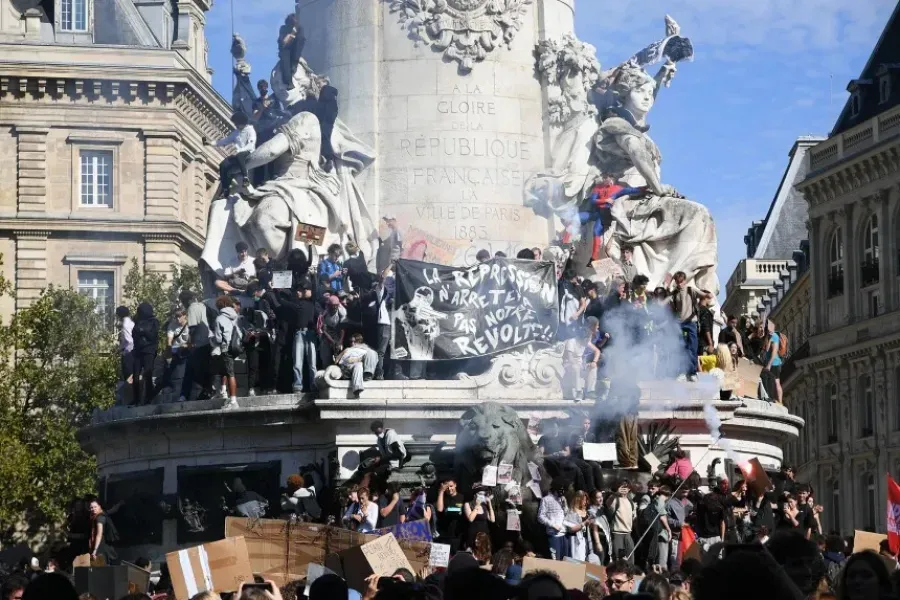
The youth movement began in mid-September 2026, when students blocked access to several high schools across France in a protest tactic known as blocus. The demonstrations quickly spread nationwide, reaching universities and then the Belgian city of Liège. Tensions escalated further on October 1, when university students joined the high school movement. According to the student union Union étudiante, 640 high schools were either completely shut down or faced attempts to blockade them. The protests reached their peak on October 6. The Interior Ministry announced that approximately 256,000 demonstrators had taken to the streets across the country, including 56,000 in Paris, while the high school students’ union USL put the figure at 450,000. An official Education Ministry report recorded disruptions to teaching at 564 of the country’s 3,700 high schools.
The scale of the confrontations is also reflected in law enforcement statistics. The Justice Ministry reported that 5,060 people had been detained since the protests began, 87% of them minors. Official figures indicate that 215 students and 715 police officers were injured. Prime Minister Sébastien Lecornu said that 85 teachers and school staff had also been injured, describing the figure as the worst record of its kind in recent decades. A symbolic turning point in the escalation came in Lens and Tours. In Lens, a 15-year-old lost his hand after picking up a police grenade, while in Tours another student lost an eye, triggering widespread public outrage. Following these incidents, France was forced to suspend the use of flash-bang grenades by police during student demonstrations.
To properly assess the current crisis, it is important to understand that the protesters’ main demand is not so much the overthrow of the government as the implementation of far-reaching reforms.
School and university students complain about teacher shortages, overloaded curricula, dilapidated classrooms and buildings unable to cope with rising temperatures. Student unions are demanding additional university places, an emergency €10 billion fund for major school renovations, large-scale teacher recruitment, a cap of €1 on student meals and an end to police brutality. School days that sometimes stretch to 10 hours have also drawn parents into the movement in support of their children. One of the movement’s most popular slogans appeared on a placard in Lille: “We want the BAC (school-leaving diploma), not BAC (the anti-crime police unit)!”
Collapsing school ceilings are a sign of a much broader structural breakdown within France’s governing apparatus. For two years, official Paris has been operating without a parliamentary majority, amid a succession of short-lived governments and a deep budget deficit. Appointed in September 2025, Lecornu is Emmanuel Macron’s seventh prime minister since 2017. Tensions in financial markets have severely constrained the state’s room for manoeuvre. Investor concerns over the budget deficit have pushed yields on 10-year government bonds above 5%, their highest level in 24 years. As a result, finding additional funding for education has become a major challenge amid heated debate over the 2027 budget proposal. The state is forced to tell young people that “there is no money”, while markets threaten to punish the country harshly if spending increases.
The international context is also noteworthy. The “Gen Z will win” slogans on the streets of Paris reflect a global trend. The fall of Nepal’s government following Gen Z protests in autumn 2025, the resignation of Madagascar’s president and the “GenZ 212” movement in Morocco have turned mass demonstrations from a theoretical concept into a tangible means of exerting pressure for French teenagers.
The most prominent historical parallel for France’s youth movement is the May 1968 unrest. A student revolt that erupted at the Sorbonne merged with a general strike involving 10 million people, and Charles de Gaulle briefly sought refuge at the military command in Baden-Baden, Germany. Yet the process ended differently: de Gaulle dissolved parliament, and the right won a landslide victory in the snap election. The spark that had ignited the streets was extinguished at the ballot box. In 1986, the police killing of student Malik Oussekine during protests against the Devaquet bill forced the government to retreat. Elements of both models can be seen in the current situation. The teenager who lost his hand in Lens is already reminiscent of the symbol of 1986, while the legacy of 1968 is reflected in the involvement of trade unions. The General Confederation of Labour’s (CGT) public services federation has called a strike for October 6–31, while TotalEnergies workers have been urged to halt production. CGT leader Sophie Binet has stressed that the union will be present in the streets to protect high school students.
Despite all this, France is currently experiencing more of a “revolutionary mood” than a “revolutionary situation”. Political theory generally identifies a state crisis, mass mobilisation, a split among elites and the existence of an alternative centre of power as key conditions for revolution. France is facing a state crisis amid financial pressure, the absence of a parliamentary majority and the approaching end of the president’s term. Mass mobilisation, however, remains partial: although hundreds of thousands have taken to the streets, there is no general strike, and transport and industry have not ground to a halt. The decisive factors are the absence of a split among the elites and the lack of an alternative centre of power. The army, police, judiciary and major businesses remain aligned with the state, while political divisions are expected to deepen only around the 2027 elections. Prime Minister Lecornu has accused La France Insoumise (LFI), the main left-wing force in parliament, of deliberately “plunging the country into chaos” ahead of the 2027 elections. LFI leader Jean-Luc Mélenchon, while fully supporting the protests, has also called for demonstrations to remain peaceful.
In a televised address on October 7, Lecornu said security forces had not been instructed to suppress the demonstrations and announced that a package of measures responding to students’ grievances would be unveiled by the end of the month. The Education Ministry’s nationwide consultation with students remains open until October 23. The Élysée Palace’s strategy is clear: channel the movement through institutional mechanisms and buy time until the autumn holidays. The streets, however, remain unconvinced. In Nantes, 17-year-old Camille told AFP that “we need action, not words”, expressing a lack of faith in the government’s promises. One particularly interesting geopolitical detail is that France’s Foreign Ministry summoned Iran’s ambassador over what it described as a “disinformation campaign” surrounding the protests. Explaining domestic crises through foreign interference is a classic reflex of weakening governments, although it is also clear that these events are unfolding against the backdrop of an international information war.
Three possible scenarios for the development of events are emerging.
The first and most likely scenario is a gradual easing of tensions. At the end of October, the government announces a compromise package on teacher recruitment and infrastructure; the autumn holidays disrupt the movement’s momentum, and the demonstrations lose intensity. The discontent, however, does not disappear—it remains embedded in public memory.
The second scenario is a convergence towards the 1968 model. Trade unions move from expressions of solidarity to a general strike, shutdowns at TotalEnergies facilities trigger fuel shortages, and another victim of police brutality galvanises society. This could lead to the government’s resignation or the dissolution of parliament.
The third, most intriguing and decisive scenario is a “revolution” at the ballot box. The energy of the streets is transferred directly to the April–May 2027 elections. In recent polls, far-right politician Jordan Bardella’s rating has stood at around 35–36%, while Mélenchon has increased his share of support on the left from 12% to 16%. The student movement mobilises left-wing voters, while the public’s growing exhaustion with street chaos strengthens Bardella by fuelling demand for stability, pushing centrist politics to the margins.
France is pregnant, but the baby may not necessarily be named “Revolution”. The lesson of 1968 is that street anarchy often ends with the victory of forces promising strict order and discipline. More than 5,000 detained young people, severely injured teenagers and bond yields at a 24-year high all point to exhaustion within the Fifth Republic’s governing machinery. The consequences of this fatigue will most likely emerge in the spring of 2027, in an electoral earthquake that France’s traditional political elite has feared for decades. To determine the next stage of the process, close attention should be paid to the CGT’s decision on a general strike, the government’s package of proposals at the end of October, any further serious injuries in clashes and the reaction of financial markets.
Political commentator: Aziz Alibeyli