
“Divorce” took place in Bishkek – Russia and Armenia “separated”
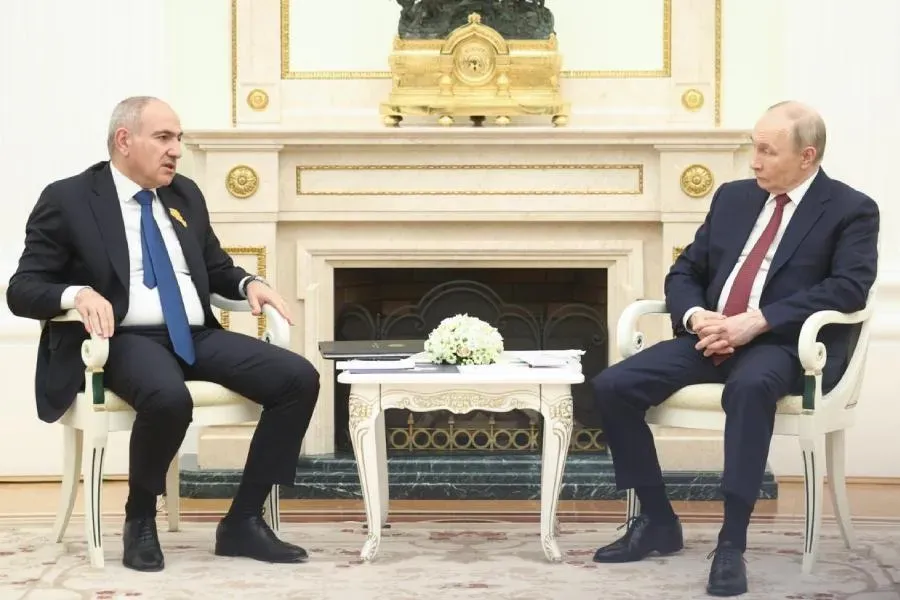
No one signed anything in Bishkek. But a treaty died there. And not just any treaty — one that had never existed on paper.
TodayPress TV reports that military expert Shahin Gojayev made these remarks.
“For 30 years, an invisible agreement operated between Armenia and Russia. Its terms were not kept in any archive, yet everyone in both capitals knew them by heart. Armenia handed over its strategic freedom to Moscow, while Moscow, in return, guaranteed Armenia’s security. The 102nd Base in Gyumri was the seal of this agreement, while the Eurasian Economic Union was its economic addendum.
In Bishkek, Putin reduced both pillars of this agreement to a conditional formula: ‘If Armenia chooses the European Union, Russia will reconsider its economic relations. If Armenia does not need the Gyumri base, Russian troops can leave as early as tomorrow.’ On the surface, these are two separate statements. In reality, they are two halves of the same sentence, whose meaning is this: the old agreement is no longer in force, and I am ready to discuss the terms of a new one.
Unwritten agreements are stronger than written ones because they cannot be challenged in court. But they have one weakness. They survive only as long as both sides believe in them. When trust disappears, the agreement disappears with it, and no one can say exactly when its funeral took place.
That trust did not die in Bishkek. It had already been dying, stage by stage.
In the autumn of 2020, Armenia saw that the guarantor did not intervene in the war. Yerevan tried to explain this at the time as an exceptional case. The base did not cover Karabakh, and there was no legal basis for intervention. However logical those explanations may have sounded, the first crack appeared in the Armenian public consciousness. A guarantee remains a guarantee only until you put it to the test.
Then came 2023, and the separatist regime in Karabakh passed into history before the eyes of Russian peacekeepers. For Azerbaijan, this meant the complete restoration of territorial integrity; for Armenia, it was the final audit of the old security model. It became an increasingly undeniable fact that Moscow’s military presence in the region had provided Yerevan with no political dividend.
Bishkek was not the beginning of this process; it was its confirmation in protocol. For the first time, the sides openly told each other about the divorce that had already taken place.
So what happens next? This is precisely where the issue ceases to be Armenia’s internal affair and becomes a regional matter.
Let us look at Russia’s calculation. The composition of the Russian delegation in Bishkek was not accidental. Sitting at the table were the heads of Rosatom, Russian Railways, and energy and transport agencies. This was not a delegation of soldiers, but of accountants. Moscow has shifted its conversation with Armenia from the language of troops to the language of tariffs, and this transition has its own logic. When influence maintained through the military disappears, a vacuum is left behind. Influence maintained through a gas pipeline, nuclear power plant and railway, however, leaves an invoice behind when it goes. Even if Russia withdraws from Armenia, it intends to measure every step of the withdrawal in financial terms.
Armenia’s situation, meanwhile, resembles a strange repetition of history. In 1918, the Armenian state emerged as an empire collapsed and fell before it could stand on its own feet. In 1991, independence came for the second time, and in the following decades Yerevan once again tied its security, energy sector, railway and market to the former center. Now the same question is knocking on the door for a third time, but the question has changed. It is no longer about which patron to choose. It is about learning to live without a patron.
Azerbaijan learned this lesson long ago. Baku never entrusted its security to a single address, never maintained a foreign garrison on its territory, and never tied its economy to a single market. When the Gabala Radar Station was closed in 2012 because the terms were not suitable, it became clear that this was neither a disaster nor an act of heroism. It was simply an ordinary decision by a sovereign state. Steps that are now being discussed in Armenia as a historic turning point have long been the norm of everyday policy in Azerbaijan. This difference in experience demonstrates the true source of power in the region. Power does not lie in the number of flags, but in who owns the decisions.
But Baku’s response to this process is not one of celebration, but of sober interest.
Russia’s withdrawal from Armenia does not, by itself, make the region stable. The question of who will fill the vacuum left behind by a departing power remains open, and there is no shortage of those seeking to occupy it. If Armenia’s military cooperation with the West deepens and this cooperation takes on a character that disrupts the regional balance, the old dependency will simply have been replaced by a new one. The past 200 years of South Caucasus history show that external guarantors bring dependence more often than they bring security. Changing the names does not change the substance.
That is why the model proposed by Azerbaijan is different. The region’s security should not be imported from outside; it should be produced within the region. A peace agreement, open communications, mutual trade and direct talks between neighbors are a more reliable guarantee than any military base. The factor that could help Armenia most on this path is not a choice between Moscow and Brussels, but the normalization of relations with its neighbors. Opening the Turkish border would give the Armenian economy more breathing room than any integration project. Expanding trade with Azerbaijan would bring more stability than any foreign guarantor. Strange as it may sound, Yerevan’s path to freedom runs not through Washington and Paris, but through Baku and Ankara.
Let us return to the phrase heard in Bishkek: ‘We will leave tomorrow.’ This statement can be interpreted as a threat or as an opportunity. But its most accurate interpretation is a question. Russia is asking Armenia: ‘Will you be able to stand on your own after me?’ The answer does not lie in Moscow. It lies in Armenia’s own economy, its constitution and, most importantly, the quality of the peace it builds with its neighbors.
When unwritten agreements die, there is no mourning. In their place, either a new dependency emerges or a state grows stronger. This is the crossroads facing Armenia, and this time neither Moscow nor Brussels will make the choice. History rarely gives the same people a third chance. The South Caucasus, for its part, is waiting to see how its neighbor will use that chance. Because in an era of open borders, the strength of every state is no longer solely its own asset — it is a resource for the entire region,” he added.
Aysel Matlab