
Who has won Europe’s wars over the past 300 years? – What awaits Russia? – ANALYSIS
Over the past three centuries, the outcome of major wars in Europe has been determined less by the manpower of armies than by economic strength and the coalitions they were able to build. From the 1721 Treaty of Nystad to the ongoing war in Ukraine, every power that sought to establish hegemony over the continent on its own eventually suffered defeat at the hands of a broader alliance: Louis XIV, Napoleon, Wilhelmine Germany and Hitler.
This article is an attempt to analyze those three centuries through concrete figures. The analysis draws on the Correlates of War (COW) project’s interstate war database, Jack Levy’s war statistics covering the great-power system, Paul Kennedy’s The Rise and Fall of the Great Powers, Ludwig Dehio’s classic thesis on the European balance of power, SIPRI’s military expenditure database, and RUSI’s analytical assessments of the war in Ukraine. Since figures vary depending on the source, the article clearly indicates the methodology and source underlying each figure.
Map: decisive battles
Of the 18 battles shown on the map, six were victories for coalitions involving Britain, while five were victories for Russia and the Soviet Union. In the west, most of the battles took place in Central Europe, on German and Czech lands. In the east, Poltava, Borodino, Stalingrad and Kursk were turning points in Russia’s defensive wars.
The major wars of three centuries
Nine of the eleven major wars were won by coalitions. The only power to win a war fighting alone was Prussia, and even that was for limited objectives. The battle casualties in the table are based on Jack Levy’s calculations and include military deaths only, not civilians. The COW database begins in 1816, so Levy’s data are used for the 18th century.
There is another line not included in the table but decisive for Azerbaijan: the Russo-Ottoman and Russo-Persian wars. Russia won five wars against the Ottoman Empire in the 18th and 19th centuries, while its wars with Persia ended with the Treaties of Gulistan (1813) and Turkmenchay (1828), resulting in the division of Azerbaijan. While a balance of power was being established in western Europe, an empire was expanding in the east.
Who won how much?
Over the three centuries, Britain is the only major power that did not end a war on the losing side. Prussia-Germany was the most successful power until 1914, but in the two world wars it lost everything it had gained. Russia won half of its victories in defensive wars.
The 12 wars considered are the Great Northern War, the Wars of the Spanish and Austrian Successions, the Seven Years’ War, the French Revolutionary Wars, the Napoleonic Wars, the Crimean War, the Austro-Prussian War of 1866, the Franco-Prussian War of 1870, the Russo-Turkish War of 1877, and the First and Second World Wars. Outcomes were assessed according to the peace treaties: a side that gained territory or status was classified as the winner, a side that lost as the loser, and an outcome that preserved the status quo as inconclusive.
Figures circulating online such as “Russia 40 percent, Germany 30 percent” are not based on any established counting methodology. The real picture is more interesting. Britain never fought alone in Europe: it financed coalitions, imposed naval blockades and relied on allied armies on land. Prussia, meanwhile, won its wars according to Bismarck’s formula: diplomatically isolate the enemy, fight a short war and keep the objective limited. When Wilhelm II and Hitler abandoned this formula, the winning streak also ended.
Three patterns
First: the last escudo. Bernardino de Mendoza, a Spanish diplomat and military commander, wrote in 1595 that victory goes to the side with the last escudo. In 1987, Paul Kennedy made this idea a central thesis of The Rise and Fall of the Great Powers: in prolonged coalition wars, economic foundations and the ability to obtain credit matter more than the quality of an army. Britain’s advantage in the 18th century also stemmed from this. London could borrow money more cheaply than Paris, allowing it to wage more wars than France. In the Second World War, too, the Allies’ industrial potential far exceeded that of the Axis powers, and this disparity became visible on the battlefield after 1943.
Second: attempts at hegemony create opposing fronts. In 1948, German historian Ludwig Dehio interpreted European history in the following way: any power seeking to dominate the continent alone eventually brings together the two great powers on its periphery — Britain at sea and Russia in the east — against itself. Louis XIV, Napoleon, Wilhelmine Germany and Hitler were defeated according to this pattern. The rule is not absolute: Prussia attacked and won in 1866 and 1870, while Russia won almost all of its offensive wars against the Ottoman Empire. The difference lay in the objectives. An attacker seeking limited territory could win, while one seeking to transform the entire system would lose.
Third: coalitions and the sea. Britain’s three-century record was the result of a strategy based on naval blockades, subsidies to allies and relying on other armies on land. After 1945, the United States expanded this model to the global level through NATO. According to SIPRI, NATO’s 32 members spent $1.581 trillion on defense in 2025, accounting for 55 percent of global military expenditure. Russia’s figure was $190 billion, or 7.5 percent of GDP. Measured according to Mendoza’s formula, the ratio is approximately eight to one.
The lesson of Ukraine and the next war
The war in Ukraine has shown that drones have changed the battlefield, but they have not abolished the three-century-old rule: prolonged wars are still decided by industry and money. The war is now in its fifth year, and neither side has achieved its strategic objectives. Over the past year, Russia has captured approximately 0.5 percent of Ukrainian territory, while the forecasting platform Metaculus estimates the probability of a ceasefire by the end of 2026 at 15 percent. In September, Kyiv and Moscow said it might be possible to return to trilateral talks in October, while the territorial issue remains unresolved.
The sea. In April 2022, the flagship of Russia’s Black Sea Fleet, the Moskva cruiser, was sunk by Ukrainian missiles. In subsequent years, much of the fleet was relocated from Sevastopol to Novorossiysk. Presenting this as “Russia losing its navy for the first time in 300 years” would be historically inaccurate: the 1856 Treaty of Paris prohibited Russia from maintaining a military fleet in the Black Sea for 15 years. Nevertheless, the picture is indicative: Ukraine, which has no navy, kept the western Black Sea open using naval drones and missiles.
Drones and shells. Drones have made the battlefield “transparent,” making the maneuvering of large tank columns almost impossible. Nevertheless, the war has returned to the old industrial logic: tens of thousands of artillery shells per day, millions of inexpensive drones and the rapid replacement of destroyed equipment. RUSI analyst Alex Vershinin described this in 2022 as the “return of industrial warfare.” This means that in the next war, the advantage will go to the side capable of mass-producing and supplying chips, shells, explosives and soldiers for years. Russia obtains microelectronics despite sanctions through third countries, mainly China; Europe, too, remains dependent on Asia for advanced chips. No one has complete sovereignty in this field.
Three scenarios between NATO and Russia
1. A short and limited clash. An incident in the Baltics, the Suwałki Corridor or around Narva could escalate rapidly. A comparison with the 1999 Kosovo campaign would be misleading: that operation lasted 78 days and was conducted against a small state without nuclear weapons. Any air campaign against Russia carries the risk of nuclear escalation.
2. A prolonged war of attrition. Here Mendoza’s formula applies in full: NATO’s military spending is approximately eight times that of Russia, while European NATO members alone spent $559 billion in 2025. However, money must be converted into weapons through factories and time, and Europe’s weak point is precisely its production capacity.
3. The most likely scenario: pressure without open warfare. Drone incursions into airspace, sabotage targeting cables and energy infrastructure, cyberattacks and interference in elections. Drone incidents in Poland and Denmark in autumn 2025 were early examples of this model.
Implications for Azerbaijan
Azerbaijan’s victories in 2020 and 2023 correspond to all three of the patterns observed over three centuries in Europe: economic advantage, a strong ally and a limited objective justified by international law.
Oil and gas revenues enabled Azerbaijan for many years to maintain a military budget larger than Armenia’s entire state budget. Mendoza’s “last escudo” rule also worked in the Caucasus.
During the 44-day war from September 27 to November 10, 2020, Bayraktar TB2 drones and loitering munitions disabled air defense systems and artillery. Western military analysts studied the war as the first interstate war of the drone era, while the Ukrainian experience later expanded on this conclusion. The victory, however, was not achieved by drones alone: the operations of ground forces, particularly special forces in mountainous terrain, recaptured Shusha.
The three-century British lesson is that victory without a coalition is impossible. The Shusha Declaration with Türkiye in 2021 represents a regional application of this lesson. Azerbaijan’s advantage was that none of the major powers united against it.
Like Bismarck, Azerbaijan set a specific and limited objective: restoring its internationally recognized borders, as reflected in UN Security Council resolutions adopted in 1993. A one-day counterterrorism operation in September 2023 completed this process. A state with no hegemonic ambitions does not provoke a coalition backlash, and Dehio’s pattern does not apply to it.
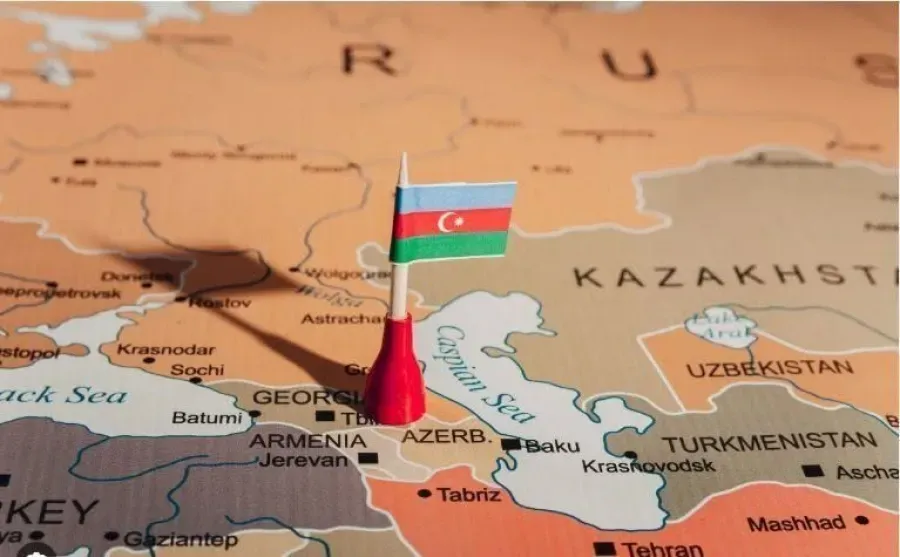
For Azerbaijan, which has access to the landlocked Caspian Sea, transport corridors play the role that the sea played for Britain. The Baku-Tbilisi-Ceyhan pipeline, TANAP, the Middle Corridor and the Zangezur route that came onto the agenda following the 2025 Washington agreement are turning the country into an indispensable transit link between Europe and Asia. This is the Caucasus version of the British model: other countries’ trade creates an interest in your security. The risk lies here as well. As tensions between Russia and NATO deepen, the South Caucasus could once again become an arena of great-power competition, while the room for maneuver of a small state could narrow.
Aziz Alibeyli
International Affairs Expert