
What Lies in the Complete Void of Space? Cambridge Scientists Capture a TERRIFYING Secret!
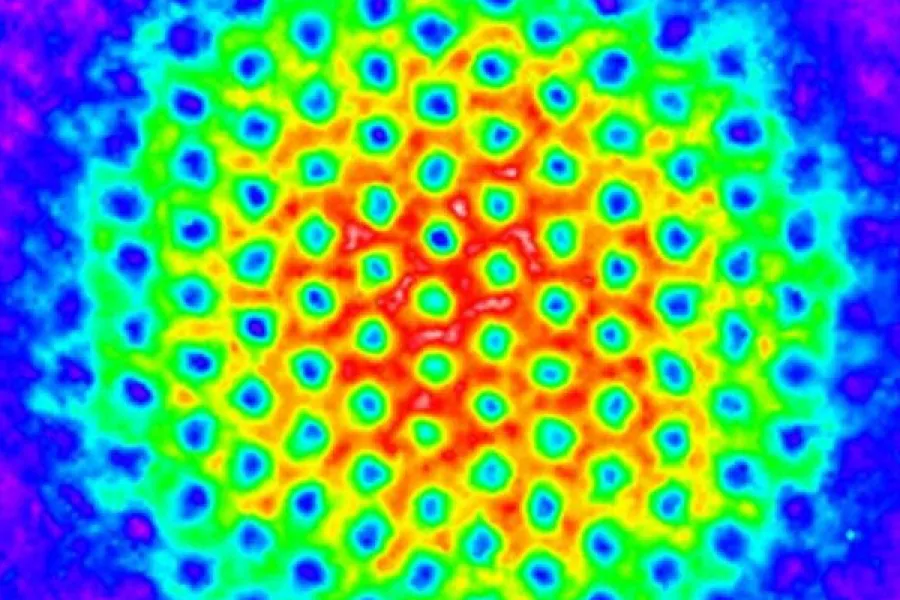
For the first time, physicists have directly captured quantum fluctuations — an unavoidable “tremor” that occurs even in completely empty space, TodayPress TV reports.
The preliminary scientific version of the study has been published on the arXiv server and has not yet undergone peer review.
According to quantum mechanics, no field can ever be completely still: because of the uncertainty principle, small fluctuations remain even in the lowest-energy state. Although these fluctuations have long been predicted by theory, it had previously been impossible to directly “see” them.
A team of scientists from the University of Cambridge, led by Yanshen Zhang, overcame this challenge by using a two-dimensional Bose-Einstein condensate consisting of potassium-39 atoms. The scientists “recorded” the quantum field in the spin states of the atoms and then photographed the atoms themselves to reconstruct local fluctuations. In other words, they made the invisible visible.
To detect the weak signal, the physicists sharply changed the strength of the coupling between the two states of the atoms and amplified the pre-existing quantum “tremor” into measurable fluctuations. Measurements conducted at different frequencies also confirmed that vacuum fluctuations produce an image noticeably different from ordinary thermal noise.
According to the authors, such a condensate can be configured to behave like a complex relativistic quantum field. This makes it possible to model phenomena that are almost impossible to calculate theoretically. These include “false vacuum decay,” particle creation and the formation of topological defects.
The scientists believe this is a new tool for studying quantum fields: whereas such phenomena could previously only be calculated theoretically, they can now be observed and modeled under controlled experimental conditions. This, in turn, could help test fundamental predictions of physics, including theories concerning the early Universe.
Qiymat Mahir